
March 6, 2026
Inside the Two-Day Race to Build the Stageline SAM750 on Miami Beach – The Team Story
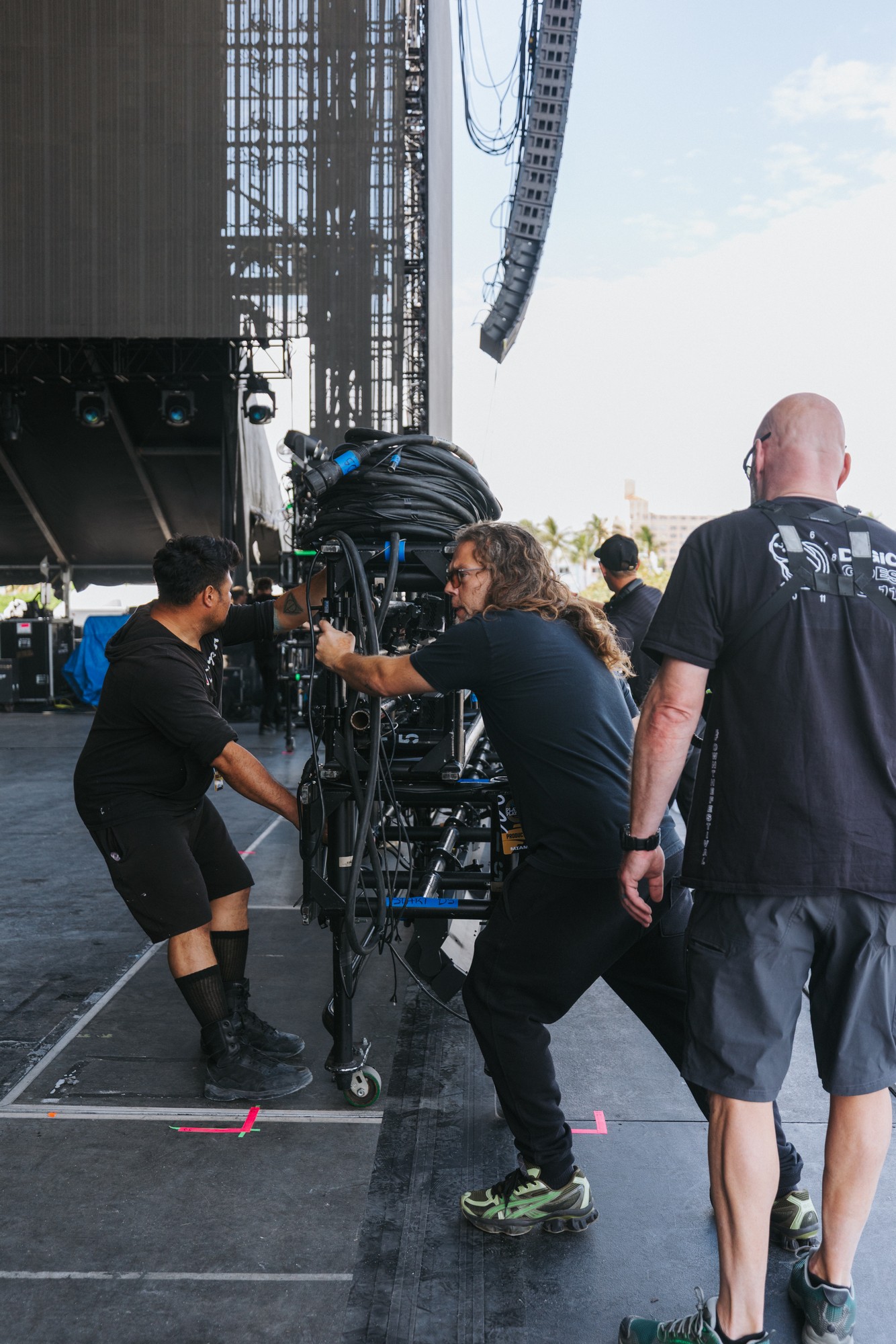
How Dane Earwaker and David Pouliot Mastered the SAM750‘s First Beach Deployment
Seven Trailers. Two Days. One Beach.
Inside the First SAM750 on Sand — With the Team Who Built It
January 12, 2026.
6:00 AM.
Seven trailers roll onto Miami Beach.
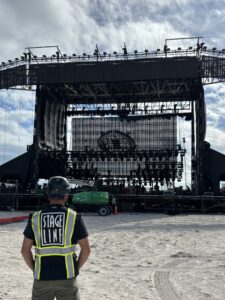
The Atlantic is already pushing wind across the sand. Police escorts move traffic. The ground beneath the staging footprint has been rolled, leveled, and reinforced with heavy-duty matting.
For the first time, the SAM750 is about to be built directly on sand.
Behind the scenes are two familiar faces from Stageline’s Rental Division:
Dane Earwaker, Logistics & Technical Advisor — 15+ years with Stageline.
David Pouliot, Lead SAM750 Technician — nearly a decade building the company’s largest mobile stage.
This is their story.
“We Knew It Was on a Beach.”
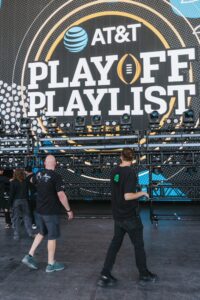
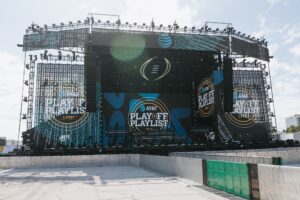
When the call came in for the AT&T Playoff Playlist Live! 2026 event tied to the College Football Playoff National Championship, the assignment sounded simple enough: deploy a SAM750 on Miami Beach. Simple — until you say it out loud.
“It was sand,” Dane says. “So the first thing we had to confirm was grade.”
Initial surveys showed roughly three feet of variance from side to side — within tolerance for a SAM750 build. But sand moves. Wind reshapes it. What you measure one month may not be what you find the next.
David flew in for a pre-site visit.
“The primary concern was leveling,” he explains. “On sand, you can’t assume anything. Even if you measure it, the weather can change it.”
The solution wasn’t modification of the stage itself — it was preparation of the ground. The production team installed heavy-duty matting across the footprint. Stageline upgraded the pad dimensions to ensure the full build zone and working area were properly supported.
“We would not have done it without the mat,” David says plainly.
The First Day: No Room for Error
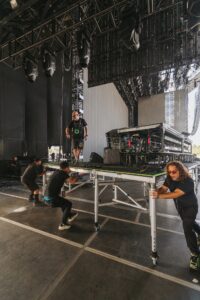
Unlike many large-scale builds, there was no staging day to pre-park trailers. The trucks arrived the same morning construction began.
“On this show, if we lose two hours, we lose the day,” David says.
Seven trailers.
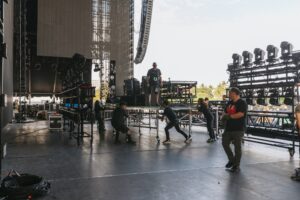
Thirty stagehands.
One crane.
Tight police-escorted trucking route through an active public beach.
Initially, the plan was to bring all trailers in at once. David adjusted that.
“We staggered arrivals. Half first, then the rest 30 minutes later. If something goes wrong, you don’t want to block the entire street with seven trailers.”
Everything hit schedule.
“Honestly, it couldn’t have gone better,” he says.
Sand Doesn’t Forgive
The stage team stayed primarily on the matting. Other trades weren’t always so lucky.
“Manlifts got stuck. Forklifts got stuck. I think one truck from another vendor got stuck four or five times,” David recalls. “If you pushed your luck on that sand, you were stuck.”
It reinforced why the SAM750 was the right choice for this environment.
With seven integrated trailers and a two-day build window, the footprint was controlled. Equipment went in efficiently and would leave just as cleanly.
“Being by the ocean, it matters how fast you can get in and out,” David says. “There’s not much waste. Everything goes back in the boxes.”
The Wind Was the Real Opponent
If sand was the foundation challenge, wind was the constant tension.
Oceanfront wind isn’t just gusts — it’s sustained movement.
“We were always close to thresholds,” David explains. “But never over.”
On every SAM750 deployment, Stageline implements structured weather protocols:
- Dedicated wind meter with real-time readings
- Pre-show safety briefing with all departments
- 30 mph : Land gear
- 40-45 mph : Prepare for evacuation protocols
- Shared weather reporting between client and Stageline
“We start by meeting with production and laying out the thresholds,” David says. “Everybody needs to know what happens as we cross each designated threshold.”
The production team trusted that leadership.
And the show ran safely.
A Stage Packed to Capacity
The creative load on this stage was one of the heaviest in its history.
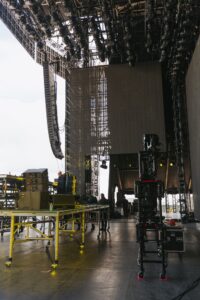
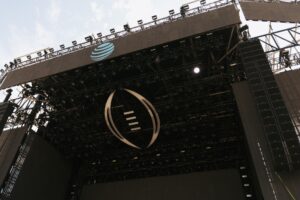
Massive IMAG screens wrapped toward the interior. A large rear LED wall filled the backdrop. An LED header framed the proscenium. Scenic steel elements — including a suspended football structure — hung center stage.
From an engineering perspective, it required coordination across departments.
“We couldn’t use an airframe for part of the video wall — it was too deep,” Dane explains. “We needed that clearance for the PA.”
The IMAGs were originally designed to connect at the corner. Wind conditions and build complexity ultimately led the video team to separate them — a practical decision in real time.
“It was full,” David says. “You could see it from the photos. The stage was full.”
Adjustments in the Field
Not everything about this build was standard.
The client requested a 12-foot-wide ramp — wider than the typical 8-foot configuration. Stageline shipped angled deck supports in advance to achieve the slope safely.
Height constraints created another challenge.
The performance area needed to stay under seven feet. Center stage landed at 6’2”.
That pushed stage left lower than typical —meaning the pipe legs had to be tailored to spec on-site.
“That happens maybe once a year,” David says. “It takes time. But you make it work.”
Two Days Up. One and a Half Down.
The build followed a tight rhythm:
- Day 1 : Floor, structure, pre-rig
- Day 2 : Roof raise, wings, final structural
- Day 3-5 : Production load-in
- Day 6-7 : Show
- Day 8 : Production load-out
- Strike : 1.5-2 days
The final crane day wrapped by early afternoon.
“Tear down is always faster,” David says. “But we still plan for everything.”
On sand, planning is the difference between smooth and stuck.
Beyond the Equipment
For both Dane and David, this project wasn’t just about a first-ever beach deployment.
It was about team execution.
“More difficult conditions than normal,” Dane reflects. “But we delivered.”
For David, it was also about collaboration.
“It was refreshing. New team. New environment. New problems to solve.”
The SAM750 stood on sand for the first time.
But what really held steady was experience.
Because in the end, the stage didn’t make it happen alone.
The team did.